Chinese New Year is a good reason to explore Koh Phangan beyond its party calendar: a Chinese temple, a north-coast village, an ordinary meal and time to observe how places are used. The useful approach is to build a cultural day that works on its own, then add a community event only when the current organiser confirms it. That gives you real places to visit without turning an unannounced ceremony into a holiday promise.
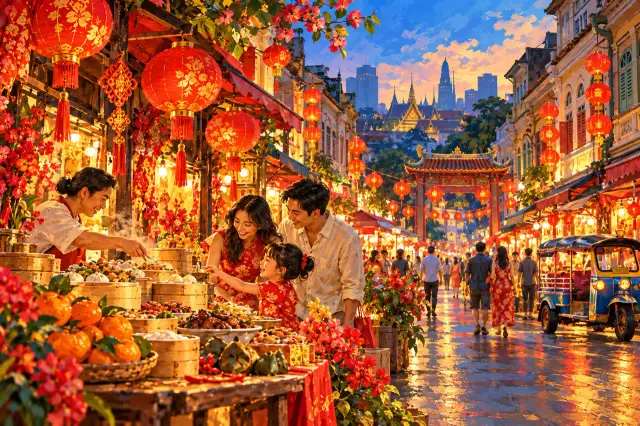
Editorial check: 16 October 2026. Lunar New Year's Day in 2027 is Saturday 6 February, according to the Hong Kong Government's published calendar. This establishes the lunar date, not a Thai public-holiday designation or a Phangan event timetable. A specific 2027 island parade, lion dance or temple programme has not been verified. The cover is an original Chinese New Year travel illustration, not a documentary photograph of a local ceremony.
Start with the actual place, not a generic festival advert
Kuan Yin Temple, also described locally as the Chinese Temple, is a normal cultural visit to enquire about. Use the exact map pin and ask your accommodation to confirm the route and current access. Some online descriptions place it inconsistently, so do not navigate from a vague reference to an east-coast temple road.
Ask whether visitors are welcome on the date and whether there is a current festival notice. A temple can be open for ordinary visits without staging a visitor-focused performance. It may also have worshippers and private community activities that are not yours to join automatically. Treat the place as a religious setting first and an attraction second.
If an activity is announced, identify who is organising it, which entrance to use and what participation involves. A photograph of red lanterns or a lion dance from another year does not confirm a 2027 programme. If nobody can verify a schedule, keep the visit as a quiet cultural stop and let lunch and the surrounding district complete the day.
A north-coast itinerary that does not spend the day driving
Have breakfast near your accommodation, then visit the temple at a time confirmed by the host. Keep the visit unhurried. Pause outside, observe how people enter and ask before moving into a ceremonial area. A short period spent reading and watching respectfully can be more valuable than a fast sequence of posed photographs.
Continue to Chaloklum village for lunch and a walk around the public parts of the bay. TAT's island overview highlights the local fishing and coconut-farming way of life in Ban Chalok Lam. Look at the village as a working place, with shops, homes and normal daily activity, rather than expecting everything to become a festival display.
Choose a meal you actually want to eat and return to your accommodation during the afternoon. If a later ceremony is genuinely confirmed, you can plan a separate return. Do not remain at the temple for hours waiting for a performance somebody mentioned in passing. A cultural half day leaves energy to enjoy the rest of the island.
For a south-coast or Thong Nai Pan stay, compare the whole return journey before adding more stops. The temple and Chaloklum combination already gives the day a clear purpose. Putting Haad Rin, several west-coast beaches and a late dinner into the same route can dilute the experience into a long vehicle circuit.
What to notice during an ordinary temple visit
Begin by observing the entrance, the arrangement of public and worship areas and the way visitors behave. Read any information provided and ask a host about what is appropriate. You do not need to perform an offering you do not understand. Quiet interest is more useful than copying a gesture because you saw it in a social-media video.
If you want to make a donation or use incense, ask where and how. Follow the temple's instructions rather than placing objects wherever there is a clear surface. Do not touch religious figures, rearrange offerings or move decorations to improve a photograph. Let worshippers approach before you when space is limited.
For children, explain a few simple differences from a beach visit: quieter voices, appropriate clothing and asking before touching things. Choose one or two details to discuss, then leave while the experience is still interesting. A child who understands why the place matters gains more than one who is hurried through a list of statues.
A food-focused celebration without an invented banquet
Ask a restaurant what it is actually cooking that day and whether there is a special menu. Do not assume every Thai restaurant serves a Chinese New Year banquet or that a red decoration means a particular dish is available. A good ordinary lunch can fit the day better than a fixed package that does not suit your group.
Order several dishes to share, starting with an amount you can comfortably finish. Explain dietary needs specifically. A vegetable dish can still contain fish sauce, shrimp paste or stock, and a mild-looking sauce may not suit an allergy. Ask what can be changed and whether a separate preparation is possible when needed.
For seafood sold by weight, agree the species, weight, cooking method and total before ordering. Ask what rice, sauces or side dishes add to the bill. This matters more than trying to compare two restaurants from an advertised per-dish number that refers to a different portion or preparation.
If you want a hotel banquet, check the year and date of the promotion and ask whether outside guests can book. Confirm the number of people the menu serves, child prices, drinks, service, tax and the deposit. A shared banquet may work well for a larger group but be awkward for two people or a family whose children will eat very little of it.
Choose the right base for a short stay
A Chaloklum or north-coast base makes the suggested cultural route easier. Check how you will reach restaurants and whether your accommodation's beach access is comfortable after dark. A property described with the same bay name can still be on a steep road or some distance from the village itself.
Thong Sala can be practical when you are arriving, staying briefly and want town services. Arrange a deliberate north-coast outing rather than assuming every attraction is near the ferry. Ask the driver for the planned route, waiting arrangement and return point. A private vehicle is transport unless you have specifically booked a guide with relevant knowledge.
For a west-coast stay, keep the cultural half day separate from an elaborate sunset plan. It is easy to finish the morning, have lunch and return for a rest before a local dinner. Thong Nai Pan and Haad Rin can still be good bases for the wider holiday, but choose the day excursion because it interests you rather than changing accommodation for a programme that has not been announced.
When you see an event notice, check these details
Look for the current year, the actual organiser and the place. A restaurant dinner, a temple observance and a street performance are different activities even if they all use a Chinese New Year heading. The lunar date does not establish the start time of any of them.
If the notice is in Thai or Chinese, ask your accommodation to help distinguish a public invitation from information aimed at community members. Find out whether there are areas visitors should avoid and whether photography or participation requires permission. An activity can be welcoming without being designed as a tourist show.
Treat previous-year notices as contact leads. They can show who organised an event, but their times and prices should not be carried forward. Save the new announcement with your travel plan once it is available. Until then, do not make an expensive non-refundable transfer depend on the hope that a parade will follow its old route.
Groups with different interests and access needs
Give the person most interested in the temple time to look without forcing everyone through several religious stops. If there is a suitable nearby place to rest, agree a clear meeting point and time. A cultural visit works better when the group knows how long it is likely to spend there and what comes afterward.
For limited mobility, ask about steps, thresholds, slopes, seating and the final vehicle-to-entrance route. A map does not explain those details. A shorter visit followed by a comfortable lunch may be more rewarding than attempting every level of a site. Ask for a photograph of the approach if that resolves uncertainty.
For children or travellers sensitive to noise, enquire about any loud performances before attending a festival gathering. Do not promise a lion dance unless it is in the current programme. A quieter ordinary visit can be the better way to learn about the place, and it can be moved to another day if the festival date is too busy for your group.
A self-guided visit or a guide?
A self-guided temple and village route works if your main interest is a quiet look, lunch and a little context from the information available on site. Save the exact locations, confirm current access and ask your accommodation for a sensible road plan. Keep expectations modest: staff or worshippers may not have time to provide a long explanation in English.
A guide can add value when you want interpretation of the religious setting or local history. Ask what knowledge they provide, the language they use and how much time is allowed at each stop. A driver who knows the entrance is providing a useful service, but that does not automatically mean they are a cultural guide. Pay for the service you actually want rather than assuming it is included.
For a small group, agree whether interpretation matters to everyone. You may get more from one well-explained stop and a good lunch than from several quick visits. If the guide cannot verify a claimed festival programme, do not let the existence of a tour title turn that uncertainty into a promise.
Two nearby dates can serve different purposes
The lunar date is the occasion anchor, but your cultural visit does not have to occur at the busiest moment. If a community programme is confirmed and you are invited, attend it at the organiser's stated time. If your interest is mainly the temple itself, ask whether a quieter day would make observation easier for both visitors and worshippers.
Keep a second day flexible if cultural participation is a major reason for the trip. An extra window can accommodate a later announcement or a changed local plan without forcing you to cancel an unrelated excursion. That is more useful than treating one unverified parade time as the fixed centre of the entire holiday.
Transport and the rest of the holiday
Agree a vehicle quote for the route you actually intend to take, including waiting time and the return. Ask whether the charge is for the vehicle or each passenger. Give the exact temple and village pins rather than asking for a generic Chinese New Year tour. If you want interpretation, ask about the guide's knowledge and language separately from the transport booking.
Use the ferry operator's own information for arrival and departure plans and keep a cultural outing away from a tight onward connection. Check the southern east-coast forecast and have a covered lunch alternative. Rain need not remove the value of the day, but it can make a long exposed walk less comfortable.
Explore the Phangan destination guide and Phangan experiences for other dates. The central distinction is between a verified lunar date, real places you can visit respectfully and a local 2027 programme that still needs its own announcement. With that understood, you can build a satisfying cultural day instead of waiting for an event nobody has actually confirmed.