Loy Krathong on Koh Phangan is an opportunity to slow down and learn from a local host, rather than another reason to race between parties. The essential decision is where and how you will participate: a small workshop, an invited community gathering, a hosted dinner or simply quiet observation. A useful plan gives you a real contact and a comfortable way to get home, without promising a ceremony that has not been announced.
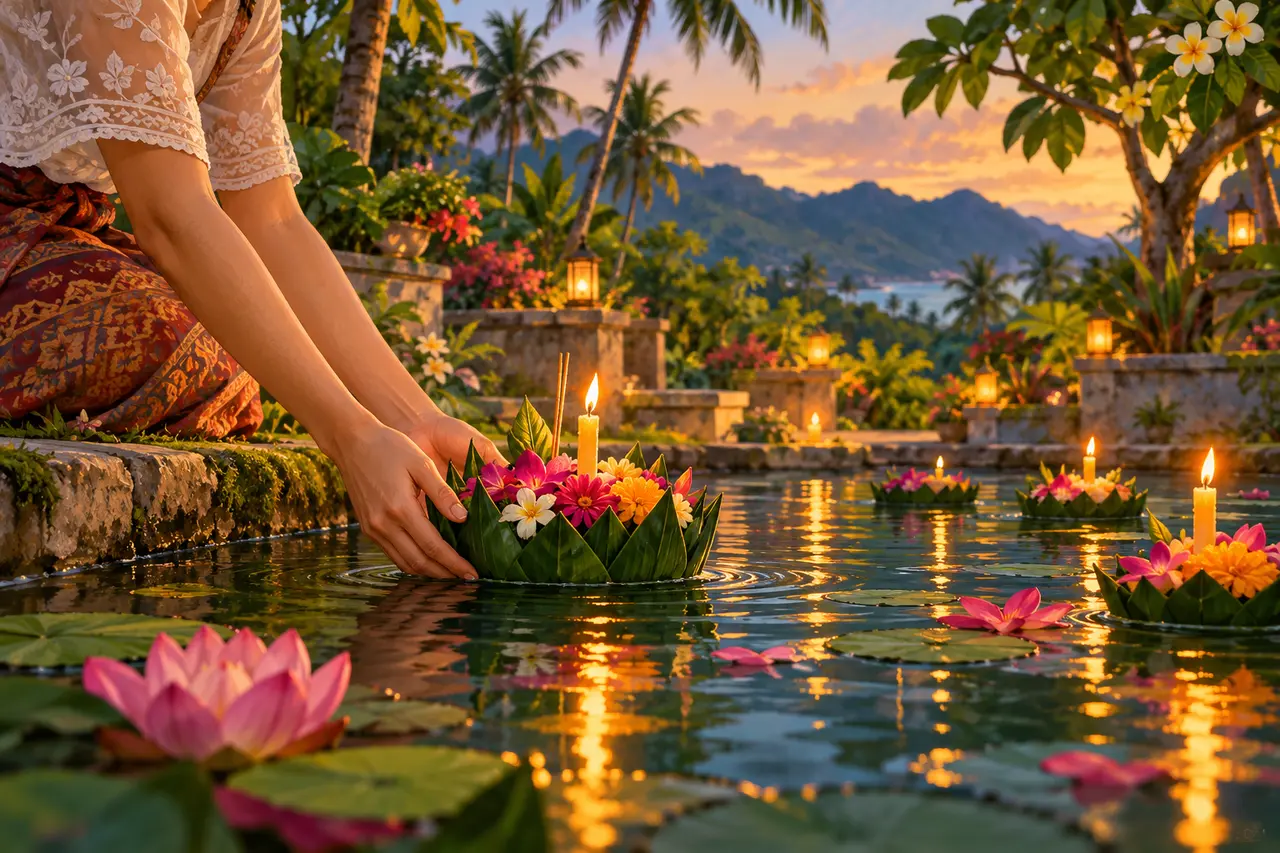
Editorial check: 16 October 2026. Plan around the national Loy Krathong evening of 24 November 2026, while confirming the actual date and time with your Phangan host. A specific 2026 municipal or venue programme on the island has not been verified for this guide. The cover is an original illustration of a floating offering on contained water, not proof of an advertised event. Routes below are editorial suggestions.
What a krathong is and why the setting matters
A krathong is a small decorated float placed on water as part of the festival. Let the host explain what the ceremony means locally and how visitors can join. Different households and organisers may approach the evening differently, so there is no need to imitate a ritual from an unrelated photograph. Watching respectfully is a complete and legitimate way to take part.
Do not confuse the floating offering with airborne lantern imagery associated with other celebrations. A Phangan evening should not be sold to you as a guaranteed mass sky-lantern release merely because a travel advert uses a northern Thailand photograph. Ask what the actual activity is, where it happens and who supervises it.
For a dated national reference, SALA Samui's published 2026 Loy Krathong programme uses 24 November. That is on neighbouring Samui, not a Phangan booking recommendation or evidence that a Phangan host uses the same timetable. Do not travel to the wrong island because a search result mentions the wider archipelago.
Find a host before choosing a water edge
Start with your accommodation. Ask whether it is hosting an activity itself, knows a current community invitation or can help contact a local organiser. Request the actual 2026 notice and the name of the person responsible. A description of last year's event can identify whom to ask, but it does not establish this year's start time or visitor arrangements.
Ask whether visitors may participate, whether materials are provided and whether a meal or workshop must be reserved. Confirm if the activity is open to outside guests or only people staying at the property. A restaurant booking should not be assumed to include a ceremony or all-day access to the accommodation's facilities.
Do not choose a working pier, temple pond or hotel pool yourself because it looks convenient. Obtain the host's designated location and use that area. A map pin establishes geography, not permission. If no suitable activity can be confirmed, plan a good local dinner and leave a short optional visit to an announced gathering rather than building the whole holiday evening around an assumption.
Choose the format that suits your group
Workshop: useful if you want to understand the float's structure and materials. Ask how long it takes, whether children can join and what an accompanying adult does. Confirm whether the finished item is stored for the evening or taken away. A long gap between a morning workshop and an evening ceremony may mean two separate journeys.
Hosted dinner: useful when seating, toilets, a clear arrival time and a predictable return are priorities. Ask whether you watch from the table or join a separate queue near the water. Check dietary options, child rates, the final bill and the rain alternative. The dinner and the ceremony may have different conditions if one part changes.
Community gathering: potentially rewarding when there is a genuine current invitation, but check the access and facilities. It may not have reserved seats, a smooth path or an English-language explanation. That does not reduce its value, but it may change whether it suits a pushchair, a tired child or someone who cannot stand for long.
Observation only: choose a suitable place identified by the host, keep out of the way and let people make their offerings. You do not need to purchase several floats to justify being there. A short thoughtful visit can be more meaningful than rushing through a crowded participation queue.
A north-coast day with an optional cultural stop
For a Chaloklum or nearby stay, have breakfast locally and make a normal daytime visit to Kuan Yin Temple only if access is confirmed. This is a religious visit, not a claimed Loy Krathong programme. Ask before approaching ceremonial areas and do not assume you may float anything in temple water.
Continue to Chaloklum for lunch and a quiet look at the village and bay. The Tourism Authority of Thailand's Phangan overview identifies local fishing and coconut-growing life here. Treat working areas and people's homes with respect; the interest is in a living place, not a staged festival backdrop.
Return to your room during the afternoon. If your confirmed evening host is on the north coast, keep dinner and the return nearby. If the only suitable activity is elsewhere, make the transfer deliberate and allow time for it. Do not add several more beaches simply because the ceremony starts after dark.
A town or west-coast version
For a Thong Sala stay, keep the day local: breakfast, a town walk, lunch and a rest. Ask for the exact entrance of any announced gathering rather than assuming it is at the ferry pier. The waterfront includes working transport space, and a general town pin is not a safe meeting plan for a ceremony.
For a Sri Thanu or Hin Kong stay, choose dinner close to the accommodation and ask about a small hosted activity. A contained-water setting with an explained collection plan can be a good option when you want participation without a difficult shoreline approach. Confirm that the activity is actually taking place; attractive photographs from a previous season do not reserve a place for you.
If the evening plan changes, the day should still work. A cultural morning, a good lunch and a normal dinner provide a worthwhile visit even if you choose not to release a float. This is more resilient than making every reservation depend on one unverified public performance.
What to ask about materials and collection
Ask what the float is made from and what happens to it afterward. A natural-looking decoration can still leave waste in the water. Prefer a host who can explain collection, separation of attachments and disposal. One shared float or participation without release can be a considered choice rather than a reduced experience.
Avoid foam, plastic glitter and decorations the organiser cannot recover. Do not add food or other objects on the assumption that they are automatically beneficial. If you join a making session, follow the host's method and ask about the structure instead of adding more items for a larger photograph.
Ask staff how clean-up is organised, but do not enter water to retrieve objects yourself. The relevant point is a supervised process with a realistic collection plan. A contained pool, pond or designated area is only a thoughtful option if the host manages what remains after the ceremony.
Families and accessible participation
For younger children, let an adult handle candles, sharp attachments and the final approach to the water. Keep loose clothing clear of flames and do not lean over an unprotected edge for a photograph. If the approach is awkward, ask the organiser for help or watch instead. Participation should not require the family to improvise a risky position.
Choose the evening around the least mobile member of the group. Ask about firm paths, steps, sand, seating and toilets. A beachfront dining area can have a different route to the ceremony than to the table. Request a clear explanation of both. A suitable viewing place may be more valuable than being at the front of the activity.
For children sensitive to noise or crowds, ask whether performances are part of the evening and where they take place. A quiet making session can be the best part of the day. Keep an early exit available and explain to the child that watching is an acceptable alternative to joining every stage.
Photographs, clothing and the return journey
Wear clothing appropriate to the setting, with shoulders and knees covered at religious sites and shoes removed where indicated. Ask before photographing people at close range during prayer or a personal offering. Avoid blocking the path to the water because it gives a better angle. Take a family photograph in a quieter area before the busiest moment instead.
Arrange both journeys and give the driver the exact host entrance. Agree a second pickup point if the closest road becomes crowded. Save the accommodation address offline and ask whether the quote is per vehicle, includes waiting or changes for a late return. A driver cannot reliably find you from a description such as near the candles.
Check the southern east-coast forecast and the organiser's rain plan. Ask whether the ceremony moves, is delayed or is cancelled while dinner continues. Those are different outcomes for a paid package. Avoid putting a sea excursion immediately before a fixed evening activity, since the return can be weather dependent.
Make the workshop educational rather than just decorative
Ask the host to explain the different parts of the float: its base, how the folded material is attached and how the decoration is kept stable. Let the organiser provide the approved materials instead of arriving with glitter, plastic flowers or extra items bought because they looked colourful. Understanding the construction gives children and adults something to learn even if they later choose not to release it.
During the making session, share one design between family members where the host permits it. One person can prepare leaves while another arranges flowers and an adult handles sharp attachments. Keep candles unlit until the organiser directs the group. The aim is a manageable activity with a meaning and a collection plan, not the largest object in a competition photograph.
Ask how the float will be stored between the workshop and the evening. If you must carry it back to a distant accommodation, consider whether a workshop-only visit or an evening-only reservation would suit the day better. A small practical detail such as storage can prevent two unnecessary transfers and a damaged creation.
If the programme is announced late
Book the parts of the holiday that do not depend on the ceremony: accommodation, onward travel and a normal meal in your district. Leave a window for the cultural activity rather than prepaying a complicated cross-island route based on last year's location.
When the current notice appears, compare its date, access and finish time with those existing bookings. Add the activity only if the whole evening fits. If it does not, a normal religious or village visit on another day can still add cultural value to the holiday without claiming to replace the specific festival ritual.
Build a useful evening before paying
Confirm the host, date, activity, visitor access, complete cost and collection plan. For a dinner, request the final total including mandatory additions, drinks and child conditions. For a workshop, find out whether the fee includes materials and later participation or only the making session. Keep those confirmations together.
Use the Koh Phangan destination guide and Phangan experience search for surrounding days. The best plan is not the one with the most floating lights in its advert. It is the one that gives your group a respectful, understandable experience, a suitable place to participate and enough time to appreciate what is happening.