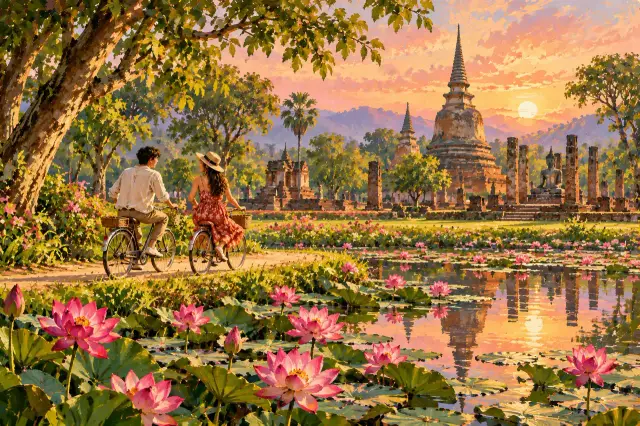
A bicycle is a good way to understand Sukhothai's historic landscape, but it is not a reason to cover every monument in one day. The important decision is where to stop riding and start looking. A compact central route provides a strong introduction. Northern monuments add another architectural experience. Western sights introduce longer riding and, in places, walking uphill. Treat those as choices, not as a compulsory circuit.
This guide uses suggested routes rather than official timed circuits. Ask the park for the current map, admission arrangements and any restricted paths when you arrive. The best route on a hot or wet day may be shorter than the one you planned at home.
Understand which Sukhothai you are booking
Modern Sukhothai town and the historical park area are different bases. Accommodation near the park makes an early ride and a midday return easier. A town stay may offer a different range of services and onward transport, but requires a transfer before the cycling begins. Check the exact hotel pin, not just Sukhothai in the address.
The UNESCO property description covers Sukhothai together with Si Satchanalai and Kamphaeng Phet. These are separate historical parks, not three zones of one bicycle rental area. Seeing Sukhothai's central monuments does not mean you have visited every component of the World Heritage property, and trying to do so in a single day would be a different transport undertaking.
If your trip gives you one full day, stay focused on Sukhothai itself. If you have a strong archaeological interest and more time, add another park as a separate day. That distinction protects the atmosphere of the bicycle visit: slow movement through one historic landscape rather than a sequence of long vehicle transfers.
Get the map and admission arrangement before riding
Use the Fine Arts Department's Sukhothai park site as the authority for current notices, then confirm the practical details at the entrance. Ask which areas require separate admission, whether the bicycle has an additional charge and how re-entry works on the date of your visit. Fees and arrangements should not be guessed from a blog written years earlier.
Mark your chosen monuments on the current map. Identify the entrance, a suitable lunch area, toilets and the place where your bicycle must be returned. This small preparation prevents a common mistake: riding towards an attractive ruin without noticing that it belongs to another area or requires using a public road.
Carry the ticket where you can reach it easily, with a little cash kept separately. Avoid repeatedly emptying a bag beside a busy gate. If riding with others, agree what happens when someone wants to stop for a photograph: the group waits somewhere suitable, or meets at a named monument. People drifting apart among similar paths can waste an unexpected amount of time.
Price the day in separate parts before deciding how far to go: the park admission for the areas you choose, bicycle rental, any transfer from your accommodation, meals and a guide if you want one. Adding another area may involve both additional admission and more riding time. Ask at the entrance what applies rather than assuming one purchase covers the entire landscape. Keep the budget comparison focused on the visit you will actually enjoy. Paying to enter an area merely because it is the last one on a list does not improve a day that already feels full.
If hiring a guide, agree where the guided portion starts, whether bicycle rental is included and how long the interpretation lasts. Someone meeting you at the main gate may not also provide the transfer from modern Sukhothai. A guide can help the central route make sense without extending it, which is often a better use of money for a first visit than adding distance. Share your interests in advance, whether that is architecture, religious art or the wider historical landscape, so the explanation can give you useful connections between stops.
Choose a bicycle for stopping as much as riding
Check brakes, tyres, saddle height and steering before leaving the rental point. Make a short test ride and ask how to contact the shop if something goes wrong. A basket can be useful, but keep weight low and secure so a bag does not swing into the front wheel. Carry water in a way that does not interfere with steering.
The right bike is one you can comfortably mount, dismount and push. Sightseeing involves repeated stops, sometimes on loose or uneven surfaces. If you have not cycled recently, start within the central area rather than testing your confidence on the road to a more distant monument. There is no need to justify a rental by riding continuously.
Ask about helmets, locks and child equipment rather than assuming they are provided. A bicycle advertised for a child needs to fit that child, and a family should decide whether every rider is comfortable around traffic before adding an outer extension. If cycling does not suit someone, ask the park about currently available visitor transport and permitted vehicle options. Attraction access should not depend on forcing the whole group onto bicycles.
The central route: begin with Wat Mahathat
Make Wat Mahathat your first major stop and allow enough time to walk through the setting. TAT's historical-sites introduction identifies it as a principal monument of Sukhothai. The Fine Arts Department's central-monuments account provides deeper context for the layout and nearby sites.
Park where directed and look at the relationship between structures, not just the best-known Buddha images. Walk around enough to understand scale and sightlines while remaining on permitted paths. An editorial forty-five minutes to an hour is a useful first allowance; a knowledgeable guide or a strong personal interest may justify much longer.
Continue towards Wat Si Sawai using the current visitor map. The change in architectural form is a good reason for the stop. Read the information board before trying to label the influences yourself. A guide can be worthwhile here if you want to understand differences across monuments, rather than only remember their names.
Move next towards Wat Sa Si and its watery setting, with a break if needed. This order is an editorial suggestion and can be reversed according to entry point, shade and visitor flow. Avoid riding onto structures or paths that are intended for walking. The bicycle is a tool for moving between sites, not for circulating through every sacred or fragile area.
Let the central route end before fatigue begins
After three substantial stops, assess the day. Do you remember the differences between them, or are you simply looking for the next name? Have water and lunch before deciding on an extension. A pause outside the monument circuit gives everyone a more honest sense of energy than a quick question asked while already pedalling towards the next attraction.
A short route can be a complete visit. TAT's 2026 cycling feature promotes exploring Sukhothai by bicycle, but enjoyment does not depend on a particular distance. You may prefer to revisit a favourite view in changing light, spend more time with interpretation or return to your accommodation during the hottest part of the day.
For photography, keep the bicycle clear of paths and other visitors. Do not use Buddha images or archaeological masonry as props, climb where access is not permitted or place equipment on fragile surfaces. A photograph is better when it records the place without altering how others can use it.
Northern extension: make Wat Si Chum the reason
Wat Si Chum offers a distinct experience and is a purposeful northern extension. The Fine Arts Department's park guide discusses the site and the Phra Achana image. Read that context before arriving so the visit is more than a familiar close view of the Buddha's hand.
Check the map for the actual approach, public-road sections and entrance arrangement. Allow time to lock or park the bike and walk. An editorial extension of one to two hours including travel and a selective visit can work for some riders, but it depends on your starting point, road confidence and how long you stay. It is not an official circuit duration.
If adding Wat Phra Phai Luang, choose it deliberately rather than treating it as a free extra on the way. Ask whether the current visitor route and admission make the pairing straightforward. Two northern sites plus the central area can be a full sightseeing day, especially with a museum visit. Leave the western extension for another time.
If the public-road link feels uncomfortable, return the bicycle and arrange another form of transport for the northern site. Changing transport is a sensible adjustment, not a failure to complete a cycling challenge. The purpose is to enjoy the monument with attention left to give it.
Western extension: budget walking energy as well as cycling
Wat Saphan Hin is associated with a hill approach, so a western outing is not simply a longer flat ride. Confirm the current route, parking and access with the park before setting off. If the climb is your main interest, reserve time and energy for it rather than arriving at the end of an already exhausting circuit.
Weather matters here. A view you hoped to see may be obscured, and wet or uneven walking surfaces can change whether the final approach is appealing. Choose footwear for the whole outing, not only pedalling. Ask your group explicitly whether everyone wants the climb and agree where to regroup if someone sits it out.
Do not schedule a hilltop stop so late that the ride back depends on good visibility, an open gate or an optimistic bicycle return time. Confirm these details first. If you want softer light at the end of the day, a shorter route close to your exit may be the more practical photographic choice.
Use the museum to make the ruins less abstract
Ramkhamhaeng National Museum is a useful companion to the outdoor sites. Check current opening days, gallery access and admission separately. A museum break should be planned around confirmed operation, not assumed to be available whenever the sun becomes uncomfortable.
Visit before the ride if objects and interpretation help you understand archaeological landscapes. Visit afterwards if you prefer to form your own impressions first, then connect them with the collection. Either order works; trying to rush through the museum between distant cycling extensions usually works less well.
A two-morning plan can be especially effective. Spend the first morning in the central area and the museum, then choose a northern or western outing on the second. This creates a natural weather alternative and prevents one long hot day from becoming the only memory of Sukhothai.
Keep a brief record of which monuments you visited, particularly if you plan to compare them with the museum afterwards. A name photographed at the start of a stop and a few words about what you noticed can prevent a day's images merging into one sequence of brick and Buddha figures. Do not interrupt the visit to produce a detailed report; a note about an unusual form, a question or a contrast is enough. If a guide has offered an interpretation, record the distinction they made rather than only the date they mentioned. This gives the bicycle day a useful thread while leaving your attention on the landscape in front of you.
Protect the final journey and keep an alternative
In heavy rain, reduce the route and ask about current visitor transport. In strong heat, take a substantial rest rather than shortening every stop until the day becomes only riding. Shade varies across the landscape, and a cool-looking photograph should not be interpreted as evidence of comfortable conditions all day.
For anyone with mobility needs, ask about the entire route from vehicle or bicycle parking to the desired view, including surfaces and toilets. An open landscape can still contain barriers. A guided vehicle visit with selected walking may suit a mixed group better than a bicycle circuit, provided the actual access is discussed in advance.
Return the bike with enough time to resolve any issue, collect bags and make onward transport without rushing. Use Sukhothai experiences to explore guided interpretation or a different format if you prefer. The most successful cycling day is usually the one that leaves you able to describe a few monuments clearly, rather than merely prove you rode past them all.