

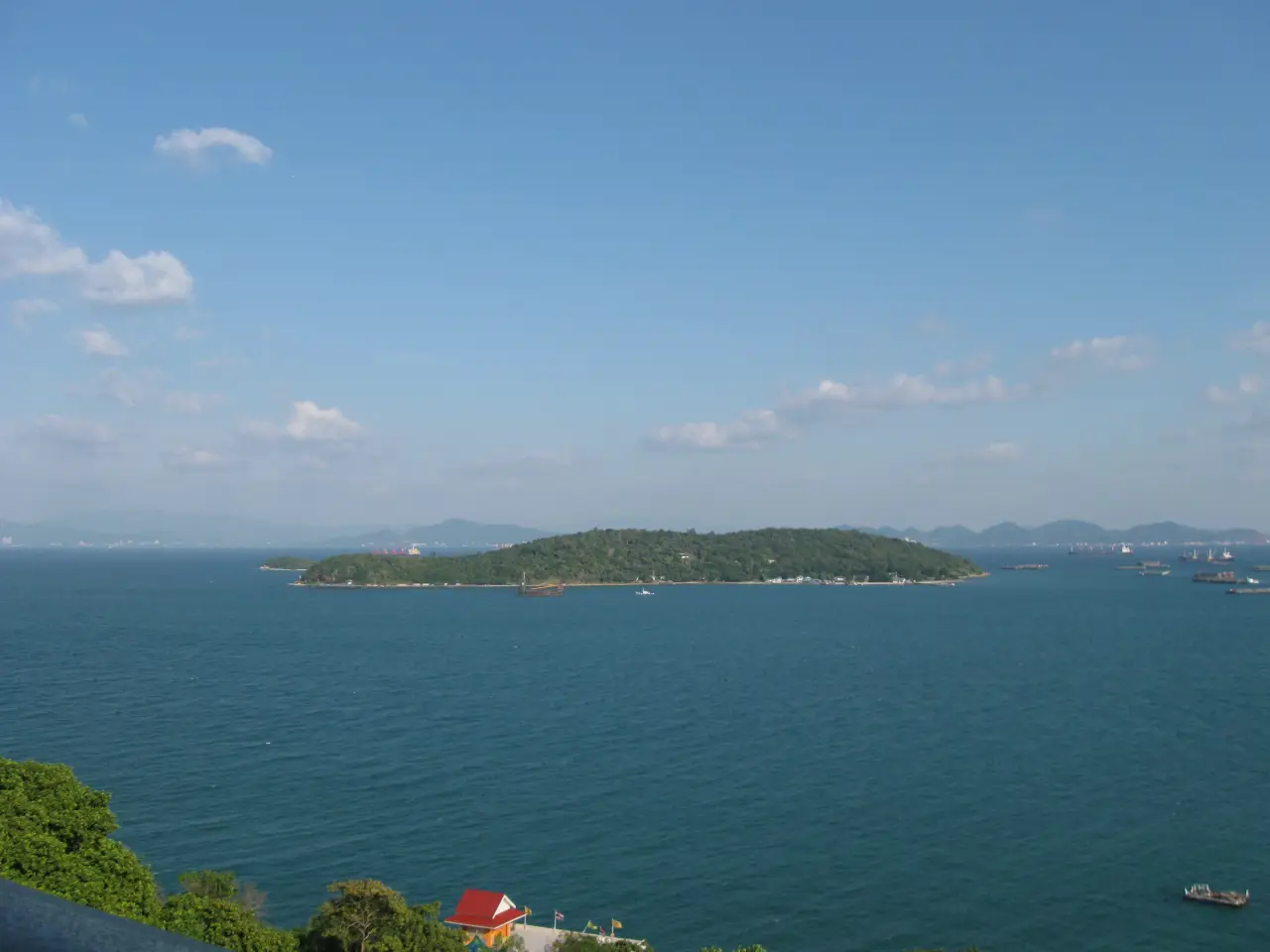
Choose the island with the palace
Ko Si Chang is an island off Si Racha in Chon Buri province. Its former royal residence provides a strong reason to visit beyond simply taking a boat somewhere. The combination of seafront grounds, smaller historic buildings and hillside architecture makes a coherent day without needing to circle every part of the island.
It is distinct from Ko Chang in Trat, Ko Chang in Ranong and the other islands reached from Pattaya. Put Ko Si Chang and the mainland departure at Ko Loi, Si Racha, into the same travel plan. Similar island names can otherwise lead to comparing unrelated transfers and accommodation.
This guide focuses on the palace grounds and a manageable day around them. It does not assume you need to rent a motorcycle or add every viewpoint. A local vehicle to the museum, time on foot and a clearly arranged return can be enough.
Choose a date when the exhibitions are open if the palace history is your main interest. The grounds and the museum rooms should not be treated as interchangeable experiences. Travelling on a closure day specifically to see indoor displays would remove much of the reason for making the journey.
Understand the former royal residence
Phra Chudhadhuj Palace was developed during King Chulalongkorn's reign as an island residence for the royal family. Its name recalls Prince Chudhadhuj, who was born on the island. English sources use several spellings, including Chutathut and Chuthathut. They refer to the same palace museum, whose Thai name is พระจุฑาธุชราชฐาน.
The palace's use by the royal family ended around the period of the Franco-Siamese crisis in 1893. What survives is not a single complete palace building waiting to be entered. It is a historic estate with remaining houses, a temple, landscape structures and evidence of buildings that changed or disappeared.
Chulalongkorn University began using part of the estate for marine science research and student training after receiving permission in 1978. The university and Fine Arts Department subsequently worked on conservation, and the palace museum formally opened in 2004. Understanding that later role explains the relationship between historical interpretation and marine learning on the same island site.
Do not expect a room-by-room tour of one intact royal residence. The experience is closer to reading a landscape through its buildings and exhibitions. The spaces between the buildings, the relationship with the shore and the preserved structures are part of the subject.
Begin by the water and Asdang Bridge
The waterfront gives the palace its setting. Asdang Bridge, also written Atsadang, projects into the sea and is one of the estate's most recognisable features. Begin with the view from the shore before joining any permitted route onto the bridge itself.
A photograph at its end can be appealing, but it should not consume the entire visit. Look back towards the estate and consider how arrival by water relates to a royal residence on an island. That perspective makes the bridge a useful introduction to the place rather than an isolated photo stop.
Keep the passage clear for other visitors and follow any temporary access instructions. Wind and rain can make an exposed waterfront uncomfortable even when a museum building remains open. If conditions are poor, start with the exhibitions and return to the shore later if appropriate.
The nearby Wooden House by the Sea is another useful first stop. The university identifies it as a visitor information and exhibition space. Its exact construction date is uncertain, so avoid treating a confident date repeated on an unofficial signboard or itinerary as established history. Ask for the currently available visitor route here before heading uphill.
Use the houses to build a history of the estate
The university assigns distinct interpretive roles to the remaining houses. Vadhana Mansion presents important events on Ko Si Chang during King Chulalongkorn's reign. Phongsri Mansion focuses on royal biography and people important to the island's history. Abhirom Mansion addresses buildings within the palace estate.
Those differences provide a practical sequence. Start with the wider story of the island and royal visits, continue to the people involved, then look at the changing architectural layout. You can approach the displays with a question rather than simply walking into every room and trying to remember a long list of names.
Names vary in English transliteration, and signs may use forms such as Watthana, Phong Sri or Aphirhom. Match the building's location and Thai label rather than assuming a spelling difference means you have missed another house. A site map is particularly useful when several small structures appear along a landscaped route.
Allow roughly twenty minutes for a selected exhibition building, extending the time where the subject interests you. That is a suggested pace, not a fixed duration. If you want a shorter visit, choose two houses that explain the estate and give the waterfront proper attention, rather than racing through everything with no time to read.
Notice how the island landscape worked
The museum preserves more than rooms and facades. University conservation accounts discuss basins, gardens, paths, stairs, bridges and water-management structures across the estate. They form part of the historic design rather than merely separating the main attractions.
Freshwater was a significant practical consideration for an island residence. The university's interpretation highlights landscape arrangements intended to collect and retain water. Looking at channels, basins and changes in ground level can make that engineering purpose visible during the walk.
The buildings also relate to a hot coastal climate. University learning programmes explain how architecture adapted outside influences to local conditions, including the use of natural ventilation. Notice shaded edges and openings as well as decorative features, without assuming every visible fitting survives unchanged from the nineteenth century.
Use interpretation on site to distinguish original fabric, restoration and modern visitor facilities. Conservation is a continuing process here. A carefully restored house can help communicate the estate's history, while still requiring an explanation of what has been retained, repaired or reconstructed.
Choose the hillside temple deliberately
Wat Asdangkhanimitr adds a different architectural experience to the waterfront and houses. The university describes a circular ordination hall surmounted by a Sri Lankan-style chedi, with Gothic-influenced doors, windows and stained glass. This combination makes it a particularly worthwhile stop for visitors interested in architecture.
It is a religious building within the historic landscape. Dress accordingly and follow the instructions at its entrance. The fact that it belongs to a museum route does not make it an unrestricted viewing platform or a place for beachwear.
Treat the approach as the walking extension of the visit. Confirm the currently usable path and consider the steps or gradient before leaving the easier waterfront route. A group with limited walking range may prefer to spend more time with the houses and shoreline instead.
Allow another thirty to forty-five minutes for the temple approach and observation, with more time if you walk slowly. Do not leave it as an impulsive final climb just before your driver is due. Its architecture deserves attention, and returning to the collection point still takes part of the outing.
A palace route of two to three hours
Begin with about half an hour at the waterfront, bridge and visitor information area. Use the first views to understand the estate's relationship with the sea. Establish which buildings are open and whether any route is affected by conservation work or an event.
Give the next hour to selected houses and their displays. Vadhana and Abhirom make a useful pairing if you want to connect the island's royal history with the vanished and surviving architecture. Add Phongsri if the biographical material interests you and the building is accessible.
Use the final part of the visit for either the hillside temple or a slower landscape walk. These are alternatives for a shorter outing, while a longer three-hour visit may include both. Build in time to return to the pickup point rather than treating the end of the final exhibition as the end of the journey.
This is an editorial route suggestion, not an official guided schedule. Visitors who read every display can spend longer. Someone arriving with only an hour should concentrate on the waterfront and one interpretive stop, rather than claiming to have seen the full estate.
Add marine learning only if it fits
Chulalongkorn University also identifies Chonlathatsathan Museum within the former palace area. Its subject is the sea and natural resources around the Ko Si Chang island group. The university describes nine exhibition zones addressing marine life, ecosystems and conservation.
It is a separate subject from the palace's royal history. That makes it a useful choice for a group particularly interested in the surrounding waters, but it should receive its own time allowance and access check. Do not assume that every research or university facility within the area is freely open to passing visitors.
For a day trip, choose between a fuller palace visit and adding marine interpretation. A family group may prefer that change of subject to another historical building. An architecture-focused visitor may want the hillside temple instead. Both are more coherent choices than adding another museum simply because it appears nearby on a map.
The presence of research and learning activities also explains why some areas have functions beyond sightseeing. Keep to the public visitor spaces, and treat organised demonstrations or community programmes as activities requiring their own invitation or booking.
Get the boat and island transfer into the same plan
The university's visitor information directs travellers to passenger boats from Ko Loi in Si Racha. Published university guides describe the crossing as roughly forty-five minutes, with regular services. Use that duration as an indication of scale and confirm the current departure timetable and operating conditions before travelling.
A boat ticket is one part of the journey. You still need to reach the mainland pier, allow time to board and travel from the island arrival point to the palace. A connection from Bangkok or Pattaya therefore requires a realistic morning departure, not simply the crossing time added to a museum opening hour.
On the island, the university describes local skylab three-wheelers and larger local vehicles as transport options. Agree the actual journey: palace drop-off, waiting if wanted, collection time and return to the departure pier. A sightseeing price for a whole island circuit is different from a simple return transfer to one site.
Keep the return boat as the day's firm boundary. Choose a service that leaves a margin for returning from the palace and boarding. Avoid relying on the last possible crossing for an onward mainland appointment. Weather or operational changes can affect an island day even when the museum itself is available.
Museum days, current information and a sensible final choice
The museum's university department page lists opening from 09:00 to 17:00, Tuesday to Sunday, with Monday closure. Check current notices around holidays, events and restoration before travelling specifically for the exhibitions. A recent university account of an organised visit does not guarantee that every building in its programme will be open independently on your date.
If you have booked a guide, confirm whether it covers the museum itself or only island transport. The university has run local youth guide training as part of its community learning work. That history is valuable context, but it is not a promise that a youth guide will be waiting for every arriving party.
Make lunch and any additional island stop fit around the palace and return connection. One substantial historic visit can be enough for the day. An overnight on Ko Si Chang gives more flexibility, but a day trip remains practical when you choose a compact route and arrange the transport clearly.
Go for the unusual combination of a former royal island estate and an active university conservation and learning site. The bridge makes a memorable first view, while the houses, water landscape and hillside temple explain why the place deserves more than a short photograph stop.
Sources and related planning
- Chulalongkorn University: palace museum, surviving buildings and opening information
- University Office of Art and Culture: the historic site, conservation and marine learning
- University Office of Art and Culture: community learning and getting to the island
- University Office of Art and Culture: 2023–2024 museum activities
- Chulalongkorn University: October 2026 visit to Ko Si Chang and its historic buildings
- Chulalongkorn University: Chonlathatsathan marine museum
- DASTA: palace grounds and Asdang Bridge
- Thailand destination planning
- Ban Krut beach, railway community and hill temple








