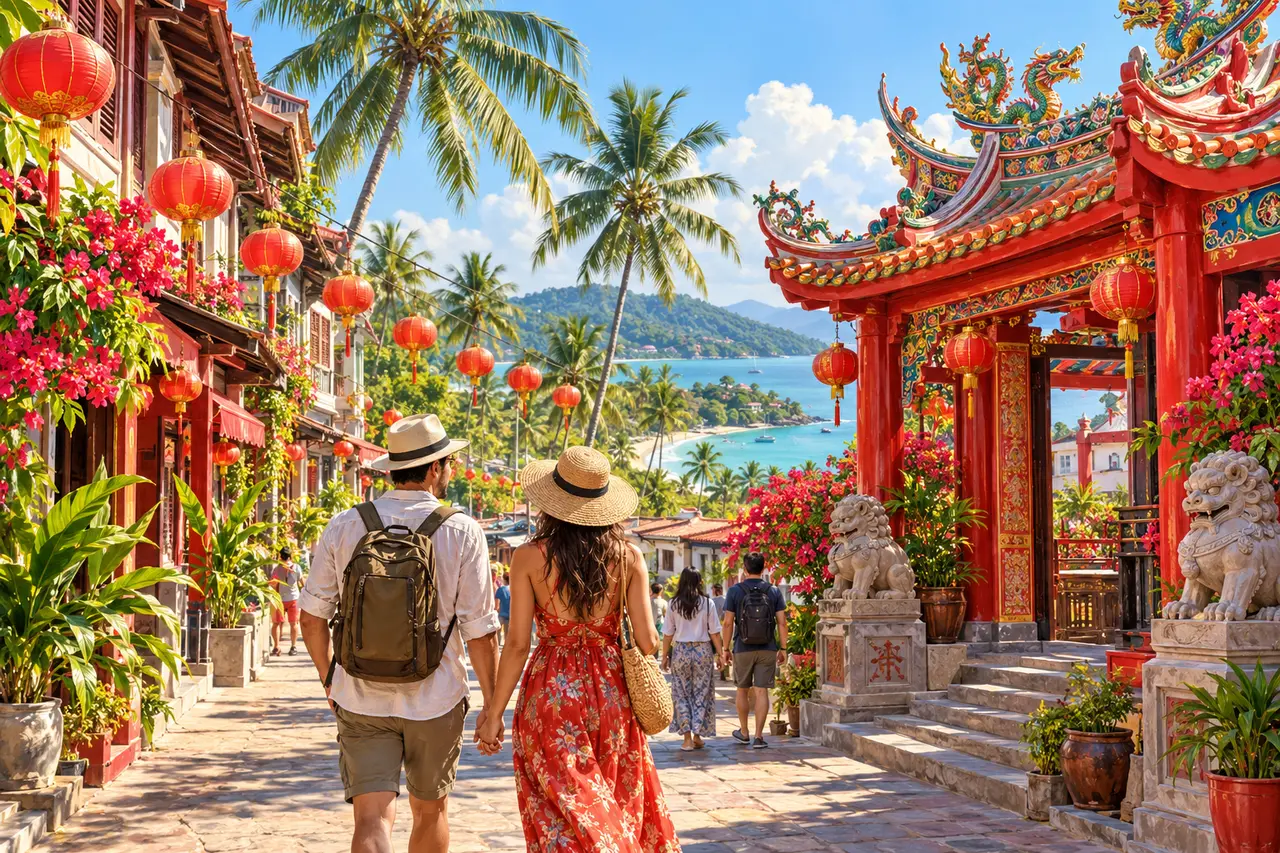
Chinese New Year is a good reason to see the parts of Koh Samui that a beach-only itinerary can miss. Build the visit around a Chinese shrine, an older town district and a proper meal. The island's Chinese heritage is visible in real places, but that does not mean every shrine will stage a public performance at a time convenient for visitors.
Editorial check: 16 October 2026. Lunar New Year's Day in 2027 falls on 6 February, as listed by the Hong Kong Government's calendar. That establishes the lunar date, not a Samui public-holiday designation or a local event schedule. No 2027 Samui parade, lion dance or firecracker timetable is confirmed here. The cover is an original heritage travel illustration, not a documentary image of a ceremony.
Choose a cultural route rather than chasing a parade
There are two useful approaches. A south/east route centres on Guan Yu Shrine in Hua Thanon and lunch around Lamai. A west-coast route centres on Nathon's older streets and its Chinese shrine. Choose the one that fits your accommodation. Combining both with northeast temples, beach time and a late dinner can create a day dominated by driving.
Ask your accommodation to help contact the shrine or community organiser about actual festival arrangements. Use a precise question: are visitors welcome on the date you plan to come, and is there a publicly announced activity? If there is no reliable answer, plan a normal respectful visit and regard any ceremony you happen to encounter as a privilege, not an included performance.
Guan Yu Shrine and Hua Thanon
Guan Yu Shrine is a Chinese religious landmark in Hua Thanon, south of Lamai. Its prominent warrior figure makes it easy to identify, but the site deserves more attention than a photograph from the ring road. Read the displays available on site and observe how the shrine is used. The Travelfish visitor account provides background on the shrine and its location; confirm access locally rather than treating a travel article as a festival schedule.
Arrive in ordinary respectful clothing. Ask before entering ceremonial areas, lighting incense or making an offering. Do not touch religious objects to improve a photograph. If a ceremony is under way, stay clear of its route and let worshippers approach first. A short quiet visit can be more appropriate than trying to remain in the centre of a busy ritual.
Hua Thanon is also a living neighbourhood with other communities and everyday businesses. Do not treat every street as a festival attraction or photograph residents at close range without permission. Ask where visitors may park and cross the road carefully. A shrine stop followed by a nearby lunch is enough to give the area time without intruding into private spaces.
A south-coast half day from Lamai
Have breakfast in Lamai, then travel to Guan Yu Shrine while you are fresh and have time to observe. Plan around confirmed access rather than assuming early morning is always best. Afterward, return toward Lamai for lunch or make a separate respectful stop at Wat Sila Ngu if the group wants another religious site.
Keep the two traditions distinct when explaining the day to children. A Thai Buddhist temple visit is not automatically part of the Chinese New Year programme. Cover shoulders and knees, follow local instructions and avoid presenting worship as a staged cultural show.
Have an unhurried lunch and leave the afternoon for the beach or your accommodation. If someone has confirmed an evening ceremony, return specifically for that rather than staying all day hoping something will happen. This approach works well for families and travellers who want cultural context without an exhausting island circuit.
Nathon for an older-town visit
On the west coast, Nathon's Hainan Chinese shrine is another place to enquire about community observances. Build the visit around a walk through the older commercial streets and lunch, with any festival activity dependent on direct confirmation. Do not assume the working waterfront is a pedestrian festival zone.
Look at the shopfronts and how the town functions beyond tourism. Stop for a drink, ask a local business for directions and keep entrances clear. If you buy food to take away, start with a small quantity and choose somewhere suitable to eat. A slower town visit gives you more than a drive-by photo and does not require an invented parade schedule.
Nathon is also a transport town. If you are arriving by ferry, separate your luggage plan from your sightseeing plan. Check whether your accommodation can collect bags or whether a driver will wait. Do not carry large suitcases through a crowded shrine visit or leave them unattended while you explore.
Make lunch part of the experience
Choose a restaurant with clear prices and order a few dishes to share rather than a large amount all at once. Ask what is available that day and whether a special festival menu replaces the normal menu. For fish or seafood priced by weight, confirm the weight, preparation and total before the kitchen starts.
Dietary descriptions need specific questions. A dish without visible meat may contain fish sauce, shrimp paste or stock. Tell staff about allergies directly and ask what can actually be changed. If children need mild food, request sauces separately where possible. A comfortable ordinary meal is a better choice than a fixed banquet that does not suit half the group.
If a hotel advertises a Chinese New Year dinner, check the year and date before comparing its price. An older promotion is not a live offer. Ask whether outside guests can book, whether drinks are required, what child ages apply and what the final inclusive bill will be. Keep the confirmation in writing.
Children, crowds and sensory needs
Ask the organiser whether loud sound, firecrackers or a crowded procession will form part of the visit. Do not promise a child a lion dance unless a dated programme confirms one. Choose a meeting point away from an entrance and keep the group together if people begin moving toward a ceremony.
For children sensitive to noise, a normal shrine visit on a quieter day may be the better cultural experience. Explain what you can see, spend a little time observing and leave before fatigue changes the mood. A festival visit is not a test of how long the family can remain in a crowd.
For reduced mobility, ask about steps, thresholds, seating and the route from the vehicle. A map pin tells you where a shrine is, not whether its ceremonial space can be reached comfortably. Arrange a shorter visit and a nearby meal when that better suits the group.
Reading a festival announcement correctly
Check the year, the place and the organiser before adding an event to your itinerary. A hotel dinner may be marketed as Chinese New Year over several evenings, while a community ceremony may take place on a different day. The lunar calendar date alone does not tell you when a local procession, offering or meal will happen.
If an announcement is in Thai or Chinese, ask your accommodation to help distinguish a public invitation from a notice aimed at members of the community. Confirm whether the activity is open to visitors and whether there are any areas you should avoid. A shared religious observance is different from a ticketed visitor show, even when both include music or decorated streets.
Read older listings as history. A useful archive can show which organisation to contact, but its times, prices and route should not be copied into a 2027 plan. Save the current contact and ask for the new notice. If nobody has announced a programme yet, the established shrine and town route still gives you a worthwhile day without claiming more than is known.
What to look for during a normal shrine visit
Begin outside and observe the entrance and the way visitors move through the space. Read any information provided, then wait for a natural gap before approaching an altar or display. You do not need to perform an offering you do not understand. Asking a host to explain is more respectful than copying a gesture from somebody else's photograph.
If you make a donation, use the designated place and follow the shrine's instructions. Ask whether incense or other items are provided and where they belong. Do not place food, money or personal objects wherever there happens to be space. If you are uncertain about entering a room, wait and ask rather than assuming that an open door means unrestricted access.
For children, choose one or two details to discuss instead of delivering a long lecture. Talk about the different use of the building compared with a beach or museum, notice the care people take with offerings and explain why quiet observation matters. Leave while the visit is still interesting rather than waiting until everyone is restless.
Keeping a mixed-interest group happy
A shrine visit works better when it is combined with a meal and a manageable amount of walking. If only one person is especially interested in religious history, give them some unhurried time while others rest nearby, provided there is a suitable agreed meeting place. Do not rush the whole group through several shrines to satisfy a list.
For a Lamai stay, the Hua Thanon route avoids a long drive to Nathon and back. For a west-coast stay, Nathon may give you a more comfortable day. If you genuinely want both, put them on separate days and connect each with its surrounding district. You will notice more when the cultural stops are not squeezed between distant attractions.
If you have a private driver, explain whether you want historical commentary or transport only. Those are different services. Ask what the guide can actually interpret and in which language, rather than assuming every driver provides an in-depth cultural tour. A well-informed guide can add value, but an invented explanation is worse than an honest limit on what is known.
Restaurant bookings during the festival period
When choosing a special meal, ask for the menu before paying. Check whether it is a shared banquet, buffet or individual set and how many people the quoted price serves. A large shared menu can be awkward for a couple or a family with young children if portions and substitutions are inflexible.
Ask whether dietary changes are possible within the banquet rather than simply requesting that a dish be removed. If several courses contain an ingredient one guest cannot eat, the alternative needs to be a full meal, not rice and vegetables left from the others. Confirm drinks, service, tax and the total for the actual headcount.
For a normal restaurant visit, keep the order smaller and add dishes if needed. Ask about any holiday change to opening or reservation conditions. A flexible lunch can be a better cultural meal than a hotel package if your interest is everyday food and conversation. Neither option is inherently more authentic; the useful choice is the one whose setting and food match your group.
Leaving time for the island itself
Give the afternoon a simple purpose: a beach near your accommodation, a rest or a town walk. You do not need to keep seeking festival entertainment after a satisfying cultural morning. If an evening activity is confirmed later, you can add it without having exhausted the group during the day.
Keep any paid excursion on another date and understand its pickup district. A cultural holiday route and an offshore trip rarely fit comfortably into the same day. The most useful plan is one that remains enjoyable if there is no parade: a real shrine, a considered meal, an older town district and enough time to understand what you are seeing.
Transport, weather and what to verify
Book a driver for the route you actually want, including waiting time and the return. Confirm whether the price covers the vehicle or each passenger. Give specific pins for the shrine and lunch district rather than a vague request for a Chinese New Year tour. Avoid expecting a driver to know an unannounced ceremony time.
Check the Samui forecast and bring water, shade and clothing appropriate for worship. Keep a restaurant alternative if rain makes a street walk unpleasant. Do not combine a fixed cultural appointment with a same-day sea excursion whose return is uncertain.
Use the Koh Samui destination guide and Samui experience search for other days. The essential distinction is between a verified lunar date, established places you can enquire about, and a local 2027 programme that still needs its own announcement. That leaves you with a useful route even if there is no visitor-focused show.