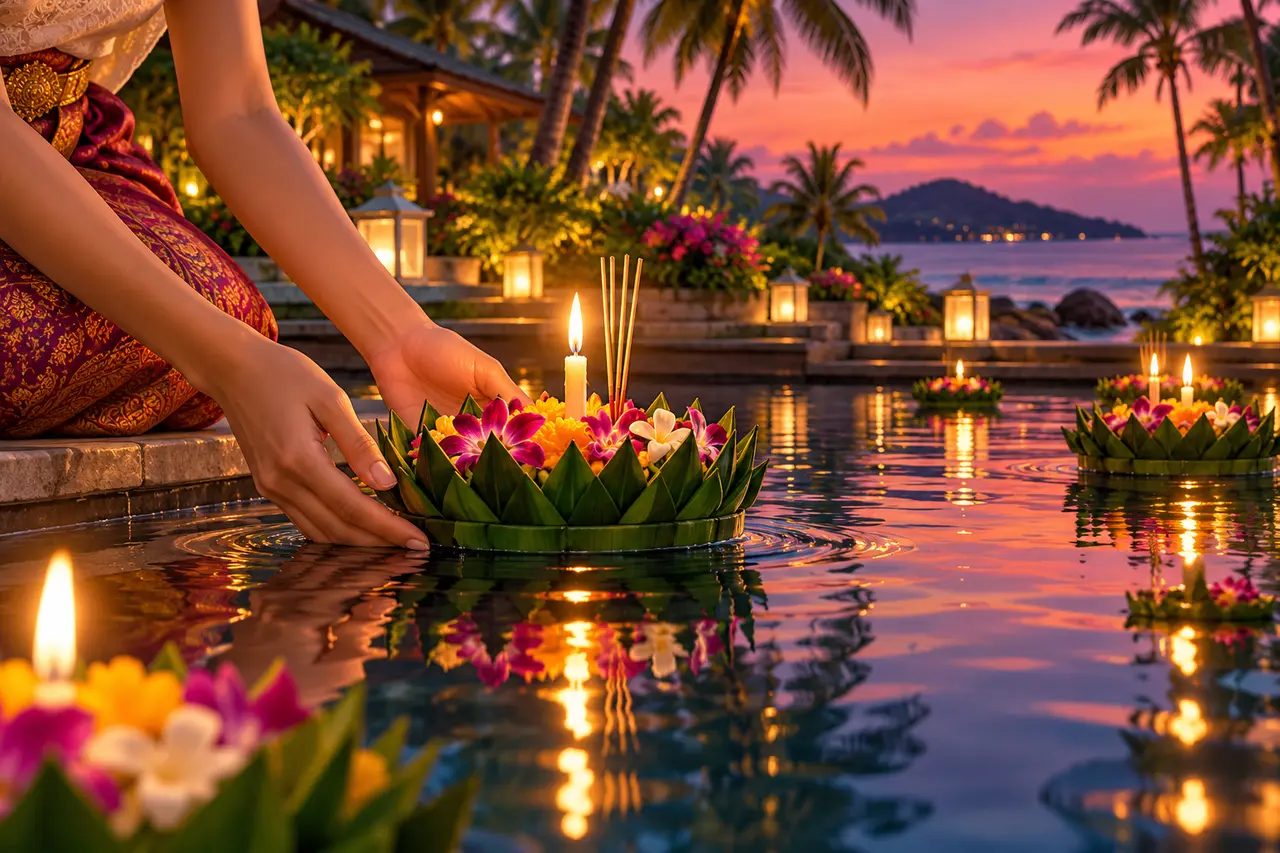
Loy Krathong on Koh Samui is best approached as a cultural evening with a practical plan for where you will take part. A floating offering, a resort dinner and a municipal gathering are different experiences. Choose the setting that suits your group, confirm that visitors can participate and leave room to observe rather than turning the ritual into a rushed photograph.
Editorial check: 16 October 2026. A published island programme below is dated Tuesday 24 November 2026. The cover is an original illustration of a krathong on contained water, not a photograph of the resort programme. Suggested routes are Tripnatic editorial advice.
What you are taking part in
A krathong is a small decorated float placed on water as part of the festival. Let the local host explain the meaning and the way they organise participation. Watching quietly is a valid choice, especially if access is crowded or the water edge is unsuitable. You do not need to release several floats to make the evening worthwhile.
Loy Krathong is distinct from the airborne lantern imagery often used to advertise northern Thailand. Do not arrive on Samui expecting a mass sky-lantern release or buy one because an unrelated photograph suggests it is part of the programme. Follow the specific host's arrangements, and use the designated water area rather than choosing your own pond, harbour edge or beach entry.
A confirmed 2026 programme at SALA Chaweng
SALA Samui Chaweng's published Loy Krathong programme lists 24 November 2026. Its morning krathong-making session is advertised from 8:00 am to 11:00 am. The evening buffet at The Tent is listed from 6:00 pm to 10:00 pm at THB 1,350++ per person, with performances and a scheduled floating ceremony at the Moon Pool at 8:15 pm. Dining-only visitors are directed to contact the resort to confirm availability.
This gives you a concrete, bookable lead with a contained-water setting. Confirm whether a dinner reservation also permits the morning workshop, whether making materials are included and whether children have separate rates. Ask for the final inclusive total, dietary arrangements, covered seating and the cancellation policy. Do not assume that morning participation includes all-day access to the resort's pool or beach facilities.
For a family, the gap between a morning workshop and the evening ceremony is long. Return to your accommodation after the workshop rather than trying to occupy the resort all day without an agreed arrangement. If your child will be tired by 8:15 pm, ask whether observing an earlier activity or doing only the workshop would be a better fit.
A local gathering requires local confirmation
Chaweng Lake is a location to enquire about, not a confirmed municipal programme in this guide. Ask your accommodation or the local organiser for the actual 2026 location, access point, start time and visitor arrangements. Do the same if somebody recommends Nathon or a temple gathering. A place that hosted celebrations in a previous year may use a different layout or have no public event this year.
Save Chaweng Lake as a geographic reference, then replace a generic pin with the confirmed entrance. A lake has multiple sides; a driver needs a specific meeting point. If a programme cannot be verified before you travel, keep it as a possible short visit and use a separately confirmed dinner as the dependable part of the evening.
Local events may not provide reserved seats, toilets close to every viewing point or a comfortable route for a pushchair. Ask those questions before bringing young children or someone who cannot stand for long. A smaller hosted activity may be the better choice when predictable access matters more than a large crowd.
A north-Chaweng day built around the evening
If you are staying northeast, have breakfast and visit Wat Plai Laem or Wat Phra Yai. Treat the visit as a separate cultural stop. Neither map pin is permission to float a krathong in temple water; ask the temple directly about any activity and follow its instructions.
Eat lunch nearby, then rest at your accommodation. For a booked SALA evening, allow time to reach the correct property and check in for dinner. SALA has more than one Samui location, so give your driver the Chaweng resort confirmation rather than saying only the brand name. That small distinction prevents an expensive cross-island correction.
If you are attending a confirmed public gathering instead, eat first and bring only what you can comfortably carry. Choose a meeting point away from the busiest water edge. Keep children close when people move toward the ceremony, and agree in advance when you will leave rather than waiting until everyone is exhausted.
Families and respectful participation
Ask a host to demonstrate how to hold and place the float. Adults should handle candles and sharp attachments for younger children. Keep clothing clear of flames, and do not lean over an unprotected edge to get a photograph. If the access point is unsuitable, let an organiser help or simply watch.
Wear clothing appropriate to the venue. At a temple, cover shoulders and knees and follow shoe-removal signs. Ask before photographing people praying or making offerings. Avoid standing between worshippers and the water because it gives a better camera angle. For a child, a short explanation and one calm activity can be more memorable than staying for every performance.
For reduced mobility, ask about the final approach to the ceremony, firm flooring, seating and accessible toilets. An attractive beachfront dinner may still involve sand between the table and the water. Request an alternative viewing place if that route does not work, rather than accepting a general assurance that the resort is accessible.
Choose a lower-waste way to participate
Prefer a host who can explain the materials and the collection plan. A float described as natural still leaves material in the water, and adding food or decorations is not automatically harmless. One shared krathong, a supervised contained-water activity or observing without a release can all be thoughtful choices.
Avoid foam, glitter, plastic decorations and anything the organiser cannot collect. Ask where used candles and attachments go. Do not release a float at a working pier, near boats or into an undesignated pool. The useful question is not simply whether the float looks traditional, but what happens to it after the ceremony.
November weather and transport
Check the Samui forecast and the host's rain plan. Ask whether dinner and the ceremony move under cover, are delayed or change format. A meal may proceed even if an outdoor activity cannot. Understand that distinction before paying a non-refundable deposit.
Arrange both journeys, with the correct entrance and a pickup location the driver can reach. For a public event, agree an alternative if the closest road is crowded. Keep your accommodation address and driver contact available offline. Do not put a sea excursion immediately before the evening; weather and late returns can interfere with a fixed ceremony time.
Workshop only, dinner only or the full programme?
A workshop is the strongest choice when the making process interests your group. Ask whether the host explains the materials and the cultural meaning, how long participation takes and whether young children need an adult beside them. Confirm whether you keep the krathong for the evening or whether the organiser stores it. That detail matters if your accommodation is far away or your family does not intend to return.
Dinner is the more predictable choice when seating, toilets and a defined arrival time are priorities. Ask where your table will be and whether you can see the ceremony from there. If reaching the water requires standing in a separate queue, find out how that works for older relatives or children. A comfortable meal and a brief view of the ritual may suit your group better than trying to participate at the busiest moment.
The full programme makes sense when you are staying nearby and everyone enjoys the activities. Check the relationship between the morning and evening bookings: they may be separately reserved, and a restaurant confirmation may not hold workshop places. Ask for one written explanation of what each person is entitled to attend, including the rules for accompanying adults.
Plan the evening around the least mobile traveller
Choose the transport drop-off and table with the whole group in mind. If someone cannot manage sand or a long standing period, ask the host for a firm route and a place to watch. Do not leave this until the ceremony starts, when staff are busiest and moving a table may be difficult. A photo of the route can resolve uncertainty more quickly than a broad accessibility claim.
For a pushchair, ask where it can be parked without blocking the way to the water. Carrying a sleeping child, bags and a float through a crowd is harder than the programme photograph suggests. Keep the number of objects small and let one adult focus on the child while another handles any offering. If the group needs to leave early, agree a car pickup that does not require everybody else to leave too.
For sensory needs, ask about loud performances and their location relative to your table. A quiet workshop in the morning may be more enjoyable than the evening entertainment. You can take part meaningfully without remaining for every stage of the programme. Let the needs of the traveller determine the booking rather than treating a late finish as better value.
What to ask a public-event organiser
Ask who is organising the gathering and whether there is an official current-year notice you can read. Confirm the precise entrance, when public participation starts and whether materials are available on site. A social post showing last year's decorations is useful background but does not establish this year's arrangements.
Ask about toilets, seating, parking and the collection process afterward. Find out whether the water edge is supervised and whether participants are expected to queue. If you are bringing a child or someone with limited mobility, explain that specifically. A general statement that everyone is welcome may be sincere without answering the access question you actually need resolved.
If you cannot obtain enough detail, keep the public gathering optional. Have dinner booked elsewhere with a flexible route for a short visit before or afterward. That way, an absent programme or a changed access point does not leave the whole evening without a plan. Do not pay an informal intermediary for guaranteed ceremony access without knowing what is being sold and who is providing it.
Photographing the evening thoughtfully
Ask permission before photographing people at close range, especially during prayer or a personal offering. Avoid flash in someone's face and do not move a float to improve the composition. A wider view of the setting can tell the story without making another person's ritual the subject of your holiday image.
If you want a family photograph, take it away from the narrowest access point and before the busiest ceremony moment. Let the child look at the activity rather than repeatedly asking them to pose beside flames. A few photographs and time spent observing will often produce a better memory than trying to record every step.
After the ceremony, follow the host's directions about leaving the area and disposing of materials. Do not assume you should retrieve something yourself from the water, and do not enter a pool or shoreline to collect a photograph. Ask staff if you want to understand the clean-up: it is part of the experience worth learning about, not simply an invisible job after the celebration.
Final decisions before booking
Decide whether your priority is ritual participation, a comfortable family dinner or a more spontaneous local gathering. Confirm the date and venue, the full cost, visitor access and the activity's collection plan. A restaurant meal and a floating ceremony should each be understood on their own terms rather than assumed to be one package.
For the rest of your stay, use the Koh Samui guide and Samui experience listings. The TAT island overview supplies broader destination context. Reconfirm the dated SALA programme directly and treat unannounced community plans as unconfirmed until a local organiser provides details.